Ultrathin Glass Cutting Technology



GIT Laser cutting of ultrathin glass (typically less than 1 mm thick) is a highly specialized process used in industries such as electronics, display manufacturing, and advanced optics.
This category of glass maintains the core properties of conventional glass while gaining unique characteristics due to its reduced thickness.
With glass being a demanding material, we offer more glass processing, including glass drilling, cutting, and dicing. Intensive research in glass machining and unique glass processing techniques ensure ultra-high precision & exceptional quality results.
With glass being a demanding material, we offer more glass processing, including glass drilling, cutting, and dicing. Intensive research in glass machining and unique glass processing techniques ensure ultra-high precision & exceptional quality results.
Benefits:
- High throughput and yield
- Straight or irregular cuts
- Less than 20 μm chipping (typ. none)
- Smooth side walls (Ra less than 1 μm)
- Ability to cut from 30 µm to 10 mm thick glass
- No debris on the back and the front surface
- High bending strength (up to 180 MPa)
- Easy adaptation for different glass types (Borofloat 33, Eagle XG, D263T, SD2, SW-Y, Gorilla, AS87, etc.) or fused silica
- Ability to cut non-glass materials (Available)
- Mechanical glass cutting (Available)
- Ability to work with metalized and optically coated glasses
- Minimal or no post-processing is needed
Key Properties
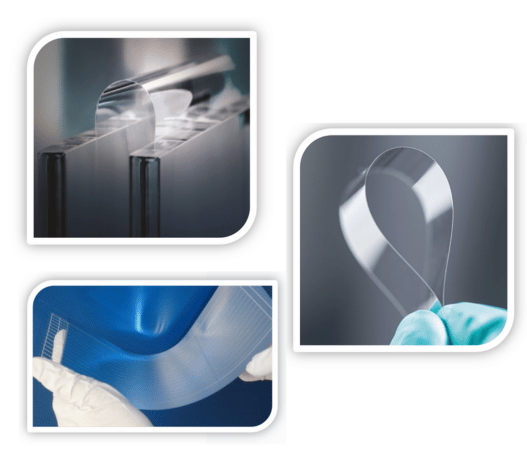
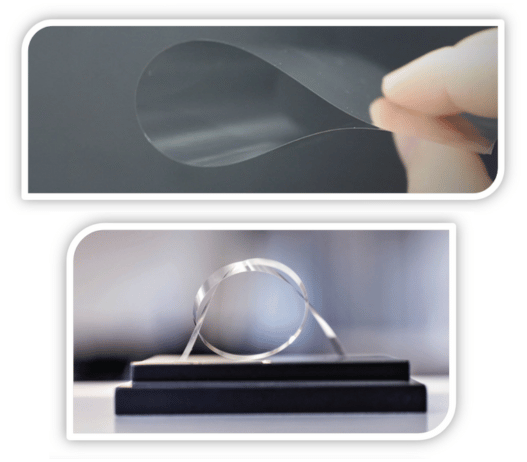
- Flexibility: Ultra-thin glass can be bent, curved, or even rolled (for thicknesses under 100 µm), enabling roll-to-roll processing and novel device designs
- Light weight: Its reduced thickness makes it exceptionally light, contributing to lighter end products
- Optical quality: It offers high transparency, low light distortion, and excellent surface smoothness, making it ideal for high-definition displays and optical applications.
- Mechanical Strength: Despite its thinness, it retains significant mechanical resilience and can be further strengthened via chemical processes such as ion exchange.
- Thermal and Chemical stability: Ultra-thin glass resists high temperatures and chemical exposure, maintaining stability and durability in demanding environments.
- Barrier properties: It provides excellent resistance to water vapor, oxygen, and other gases, outperforming many plastics and polymers.
Industrial
Applications

Cutting-Edge Technologies
Industries and Applications that Benefit with GIT Laser Technology